
Lowndes Tax Fields Explained
Assessment and collection answer different questions in Lowndes County. The public GIS handles parcel identification and offers assessment filters. The Revenue portal's View/Pay Property Taxes entry belongs to the billing side. Neither screen alone is a complete property record. So plan to use both.
| Field | What It Shows | Where |
|---|---|---|
| Appraised value | Fair or reasonable market-value estimate | Assessment record |
| Classification | Ratio applied under Alabama law | Assessment record |
| Assessed value | Appraised value times classification | Assessment record |
| Exemption / current use | Relief or alternate Class III treatment | Assessor office |
| Bill and payment status | Amount due and collection record | Revenue portal or Tax Collector |
| Parcel / account | Cross-system identifier | Card, GIS, and tax records |
Here is the arithmetic Alabama uses. Appraised value is multiplied by a classification ratio to produce assessed value. Then millage and exemptions are applied. A mill equals .001. Class II property is generally assessed at 20 percent. Qualifying Class III agricultural, forest, owner-occupied single-family, and historic property sits at 10 percent. Treat the resulting figure as a tax base. Never treat it as evidence of what the parcel would sell for.
Search the Lowndes Assessment Roll
The Lowndes parcel search takes a wide range of inputs. Options include Account, Parcel(s), Owner, physical number, street name, acreage and tax-list value ranges, District, UseCode, ExmptCode, Subdivsn, deed book/page/date, and section-township-range. The form does not expose its required fields or dropdown values up front.
| Search route | Best use | Save from result |
|---|---|---|
| Physical address | Known property | Parcel and account |
| Owner | All assessed parcels under a name | Exact owner wording |
| Parcel / account | Precise cross-check | Leading zeroes and format |
| Value / code filters | Assessment research | Tax year and labels |
A sample card from Lowndesboro shows the depth of detail available. It lists Owner Name, a mailing address, deed book/page/date, acreage, district, S-T-R, exemption, subdivision, and neighborhood. Field layout and update timing on live results vary.
Lowndes Tax Portal Is Separate
The Lowndes Revenue portal exposes View/Pay Property Taxes and account tools. The tax-search form is behind an interactive postback, so exact fields, year selectors, and print options were not confirmed. Call the Tax Collector at 334-548-2175 when the public entry does not resolve the bill.
The portal notice states a 3 percent processing charge with a $3.50 minimum. Verify its application before paying. The public assessment search remains useful for finding the parcel identifier first.
The official revenue screen below shows the entry point used for Lowndes property tax records.
Open the Lowndes Revenue portal before using its payment controls.
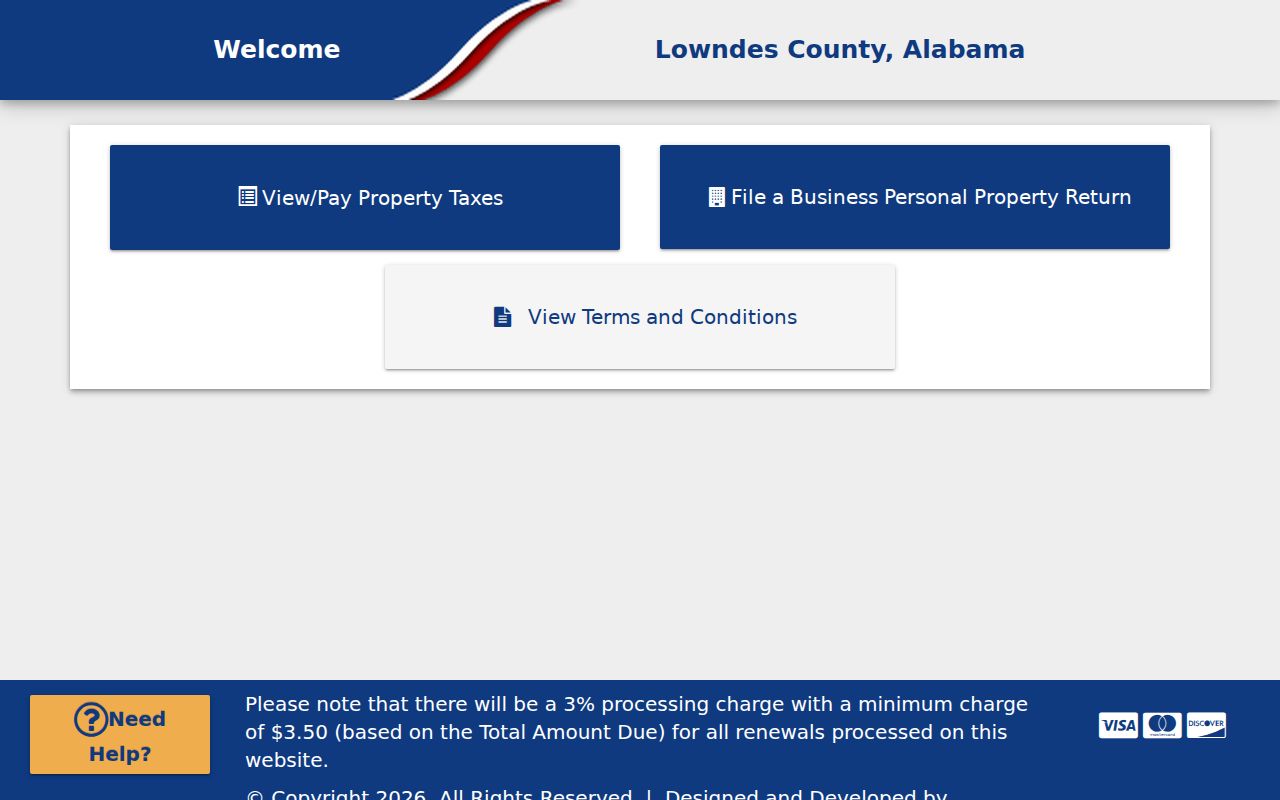
The screen confirms the separate county tax channel and the portal's payment notice.
Look Up a Lowndes Tax Bill
Start with the parcel card. Then carry that parcel number into the collection system. This habit keeps a street variation or an old owner name from becoming your only search key.
- Find the parcel and account in Public GIS by physical address or owner.
- Open View/Pay Property Taxes and use the identifiers the live form accepts.
- Compare classification and exemption with the assessment record.
- Ask the collector about any unclear balance, delinquency, or sale status.
- Assessed value
- The classification-based value used before millage.
- Millage
- The levy applied to assessed value.
- Homestead exemption
- Relief for a qualifying owner-occupied home.
- Tax lien
- A public claim tied to unpaid property tax.
Alabama Tax Dates Shape Lowndes
The state's calendar drives everything. According to the Alabama Department of Revenue, property taxes are due October 1. They become delinquent after December 31. Delinquent property then moves to Probate in February. The Probate Court meets in March. Advertising runs in April. Tax sales follow in May. Assessment work also repeats annually. The assessor reviews one-fourth of the county each year. A full review comes on a four-year equalization cycle. New buildings are valued as they appear. Owners should report improvements, or removals, existing by October 1. The Revenue Commissioner must receive them by December 31. Paying taxes proves nothing about title. Alabama's delinquent land guidance flags title and redemption complications around tax-sale property.
Lowndes Homestead and Current Use
Homestead in Alabama generally means a qualifying single-family owner-occupied dwelling. It also includes land up to 160 acres. Exemptions H-1 through H-4 carry different age, disability, income, state, and county rules. Apply through the county office, and confirm current proof requirements there. Class III agricultural and forest property may qualify for current-use valuation instead of market value. A new owner must apply between October 1 and January 1 after a sale. Otherwise the parcel may jump back to fair and reasonable market value. Old Lowndes County property tax records predict a new owner's bill so poorly. That is why. The Alabama homestead page holds current statewide details. Meanwhile, the local office applies them parcel by parcel.
Owner Names Can Lag Lowndes Sales
The Alabama Department of Revenue warns that a tax bill can stay in a previous owner's name after a purchase. The buyer's job is to record the deed in Probate, assess the property with the Revenue Commissioner, bring the deed along, and submit mailing-address changes in writing. The tax-name field is an administrative snapshot. It is not final proof of title. Four items deserve comparison: the deed recording date, the assessor's Owner Name, the owner mailing address, and the tax year. A freshly recorded deed is often the stronger timing signal even while the bill still carries an older name. And that lag does not shift responsibility. The buyer owes the taxes regardless of what the bill says. Note: Never decide current ownership from the tax-bill name without checking the newest recorded deed for the same land.
Lowndes Tax-Sale Records Need Context
Delinquency can move a Lowndes County tract through a long chain. It starts with county collection. From there the tract runs into Probate proceedings, public notice, sale, redemption, and possibly state-held land records. Read any tax certificate or tax deed with care. Redemption rights, lingering interests, and title defects may all survive the sale. The Alabama Book of Lands can fill gaps in county files. So can the Department of Revenue's land-sale resources. Paying taxes alone never establishes ownership. For a specific tract, compare the collector's account and the Probate sale and deed records. Also check any court filings and the ordinary deed chain running back through the recorder's books.
Keep copies of everything you touch. That means each dated notice, assessment card, bill, receipt, and protest. Record the tax year beside every value, because an annual reassessment, an exemption change, a transfer, an improvement, or a statutory cap can make two screens disagree while both accurately reflect their own reporting periods.
The Seven-Percent Cap in Lowndes
Act 2024-344 guidance lays out a seven-percent cap on taxable assessed value. It applies to certain Class II and Class III real property. The cap ties to the tax base on October 1, 2024. It also ties to collections beginning October 1, 2025. It runs through the fiscal year that starts October 1, 2027. For Lowndes County owners, that ceiling limits how fast the taxable figure on a parcel can climb year to year.
Ownership changes the picture. A sale resets taxable assessed value to true assessed value for the following tax year. Capped value and true value can then diverge on the same parcel. Read the labels on your Lowndes County tax bill with care. Match each figure to its field and tax year. Avoid grabbing the biggest number from an old bill.
Contest a Lowndes Assessment
Disagree with your assessment? Act quickly. A taxpayer who disputes value must file a written protest with the County Board of Equalization within 30 days after written notice. The authority comes from Ala. Code §§40-3-20, 40-3-24, and 40-3-25.
A strong protest packet makes the review easier. Include parcel facts, photographs, comparable evidence, and a clear statement of the disputed value so the board can see exactly what figure you contest.
Appeal window. File the written Lowndes protest within 30 days of the value notice. Confirm receipt and the local hearing process with the Board of Equalization.
Review Alabama's appeal instructions before filing.
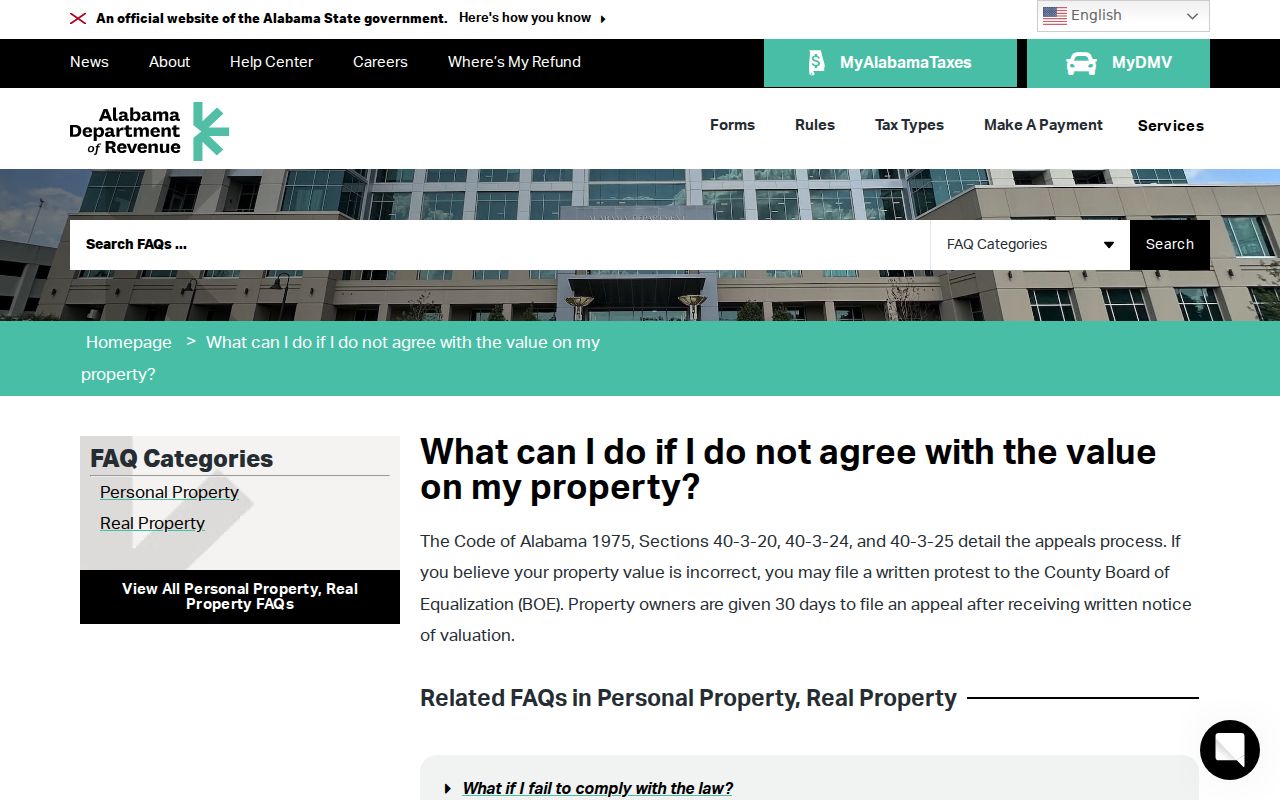
The state page confirms the written protest route and the time measured from notice.
How Alabama Computes Lowndes Tax
The Alabama assessment page breaks a bill into its parts: appraised value, classification, assessed value, millage, and exemptions. That breakdown matters when you compare two Lowndes parcels. Similar appraisals can still produce different tax bills once classification or relief enters the math.
The state formula is only half the story. Lowndes County assessment and collection records supply the parcel-specific inputs, so the two together explain the final number on a tax bill.
Need sale and assessment figures beyond the bill itself? The Lowndes County property values record covers them.