
Compare Three Lowndes County Property Values
One Lowndes County property value can mean three different things. It may be an appraised market figure. It could also be a classification-based assessed amount, or the consideration tied to a past sale. Alabama appraises taxable real estate at fair and reasonable market value first. It then applies the property's classification ratio to arrive at assessed value. A transaction amount, when available, comes from the recorded conveyance or its recordation-tax context.
| Value | What It Is | Where |
|---|---|---|
| Appraised market value | County mass-appraisal estimate of fair and reasonable market value | Assessment record when shown |
| Assessed value | Appraised value multiplied by the Alabama class ratio | Assessment roll and tax calculation |
| Last sale consideration | Amount associated with a recorded transfer, when disclosed | Deed, recordation-tax stamp, or transfer record |
The county parcel card does not display a reliable sale-price or market-value field. Treat any web result showing one with caution. A deed or recordation-tax context may supply transfer evidence, but even that is no substitute for a current appraisal.
Look Up an Assessed Lowndes County Property Value
The Lowndes Public GIS parcel search offers search controls for physical address, owner, parcel, account, acreage range, TL Value range, district, use code, exemption code, deed date, and section-township-range. Match the parcel number and tax year shown in the result. That way the value has context.
- Search by physical street number and name, parcel, account, or owner.
- Open the correct tract and note the year, class/use, exemption, and every labeled value.
- Apply the correct Alabama class ratio only when starting from appraised market value.
- Check the recorded deed separately if a sale or consideration figure is needed.
- Assessed value
- The appraised amount after the property's classification ratio is applied.
- Market value
- The fair and reasonable value estimated through mass appraisal.
- Assessment ratio
- The class percentage used to turn appraised value into assessed value.
- Sale consideration
- The transaction amount associated with a recorded instrument when stated.
- Reassessment
- A later official valuation of the parcel.
Apply Alabama Ratios to Lowndes County Values
Alabama's real-property classes do not share one ratio. Class I utilities use 30 percent. Class II property not otherwise classified uses 20 percent. Class III agricultural and forest land, qualifying owner-occupied single-family property, qualifying manufactured homes on owned land, and historic buildings or sites all use 10 percent. That ratio is why assessed value sits below appraised market value in most cases. Know the classification before comparing parcels. Class III current-use treatment adds another wrinkle, since eligible land may be valued for current use rather than fair market basis.
Note: Classification and current-use status can make two nearby Lowndes County assessment numbers unsuitable for a simple comparison.
See the Lowndes County Value Search Source
The official county GIS source links property searches to the assessment system.
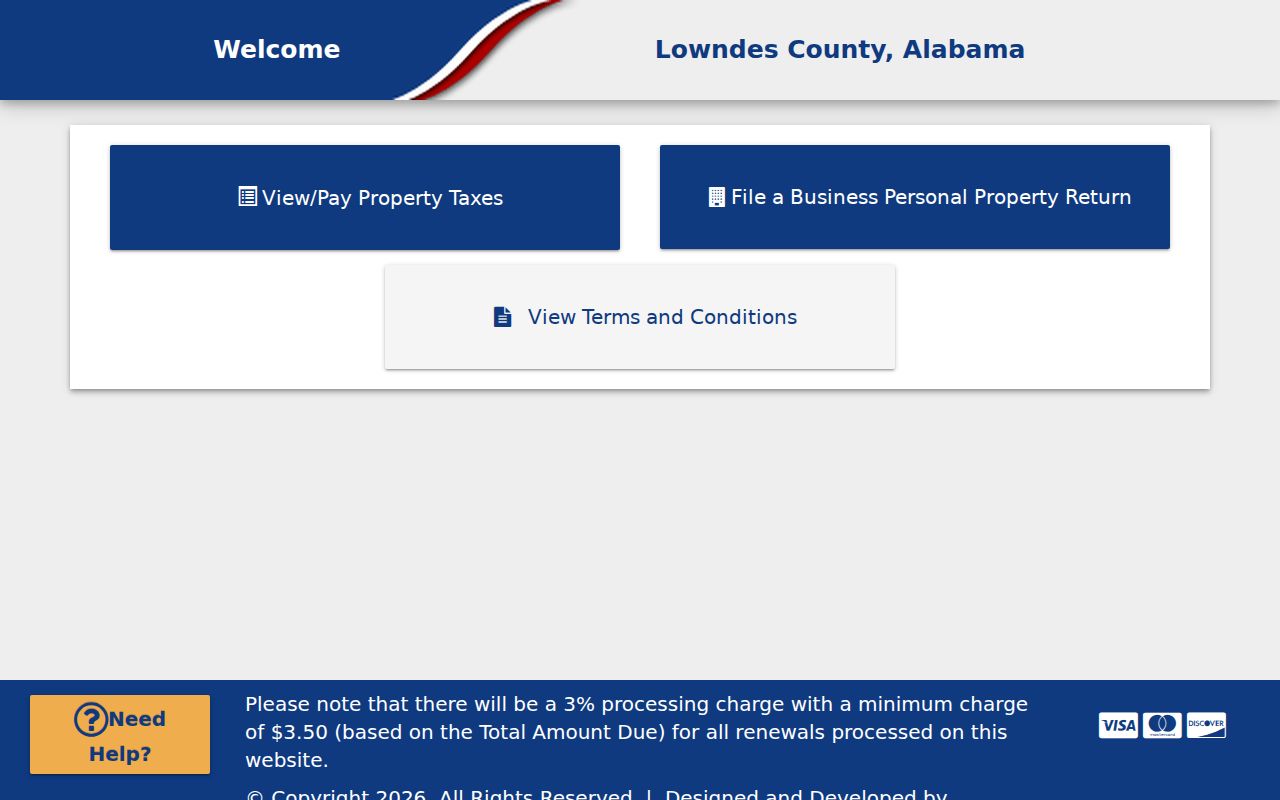
The county's own entry page is the official starting point for value searches. It publishes no update timestamp or complete listing of live value results.
Lowndes County Values Follow a Four-Year Review Cycle
Alabama DOR describes an annual reappraisal program. An assessor reviews one-fourth of a county each year. Full review arrives through a four-year equalization cycle. New buildings and property changes are assessed as well. Because of that stagger, two displayed values can reflect different review stages even when their parcels sit side by side. Owners must report improvements or removals existing on or before October 1 by visiting the Revenue Commissioner by December 31. That schedule belongs to the assessment process. It does not predict a sale price.
The Seven-Percent Cap Changes Lowndes Comparisons
Act 2024-344 created a seven-percent cap for specified Class II and Class III real property. DOR says tax-base implementation began October 1, 2024. Collections began October 1, 2025. The measure runs through the fiscal year beginning October 1, 2027. Because of the cap, taxable assessed value can drift away from true assessed value. A change of ownership triggers reassessment. It resets taxable assessed value to true assessed value for the next tax year. So a prior owner's capped number offers little guidance for a buyer's later basis.
Current Use Can Lower a Lowndes County Value
Lowndes County's rural and agricultural land makes Alabama's Class III current-use rules especially relevant here. Eligible property can be valued according to current use. That is a different basis than fair and reasonable market value. Do not read that amount as the tract's likely open-market price. After a sale, DOR says the new owner must apply for current-use treatment between October 1 and January 1. Otherwise the property returns to market basis. That timing alone can explain a sharp shift in value. No physical change to the land is needed.
Find a Lowndes County Sale Amount in the Deed Trail
Alabama imposes deed recordation tax at $0.50 per $500 of value. A deed or tax stamp can give consideration context. It helps when the parcel card shows no reliable last-sale field. Still, the transfer date and legal description must match the subject parcel. Any sale amount can reflect family transfers, partial interests, bundled land, or other special terms. Treat it as historical transaction evidence, not a current market estimate. Ingenuity's image access may require an account or a pay-per-document purchase. The current price for documents is not published.
Get Lowndes County Valuation Help Offline
Call the Lowndes Assessor at 334-548-2588 when a value label, classification, exemption code, or parcel match is unclear. The public page lists a P.O. Box 186 Hayneville contact. An Alabama Code §36-12-40 request may seek a specific public assessment record, though the county publishes no universal response deadline or copy fee. For transaction context, Probate is listed at 334-548-2365 by the judicial directory and 334-548-2843 by the state directory. For the separate bill, exemption, and protest process, use the Lowndes County property tax records resource.
The Lowndesboro Card Shows What Not to Assume
The ADECA card packs in plenty: parcel, account, deed book and page with its date, owner of record, mailing address, acreage, district, section-township-range, exemption, subdivision, and neighborhood. What it does not reliably show is a last-sale amount, a market value, or a split between land and improvements. Headings and nearby layout text are not data. A build should never scrape them into invented amounts.
The sample deed date is old. Subdivision and neighborhood entries are effectively blank. That mix is the lesson: a current value must come from the live labeled field and its stated tax year. Cross-reference keys hold up even when the valuation field you want is not there.
State Sales Studies Do Not Price One Lowndes Parcel
Each year the Alabama DOR runs sales-ratio studies. They draw on sales plus market, cost, and income data for every county. Those studies grade countywide valuation performance. They cannot price one Lowndes County tract. They never substitute for an inspection or appraisal of that parcel.
To compare parcels fairly, normalize the tax year, classification, current-use treatment, cap status, and any ownership change first. Then weigh physical differences and reliable sale terms. A countywide ratio or a nearby assessed figure alone will not establish a subject property's market price.
What a Lowndes County Property Value Cannot Prove
An assessed value exists to support taxation. It cannot prove a sale price. It cannot prove a lender's collateral conclusion. It cannot prove the worth of improvements on an inspection date. It cannot prove the exact value of a partial interest. GIS geometry and neighborhood labels do not convert the number into a parcel-specific appraisal either.
When comparing Lowndes County property values, carry the year and class ratio. Carry current-use status, cap status, ownership change, and source label alongside every figure. A qualified appraisal of the specific property answers a different question than mass assessment does.
The Alabama formula keeps terms straight. Appraised value times classification gives assessed value. Assessed value times millage gives the unadjusted tax, and exemptions shape the adjusted bill. Millage belongs to tax math, not market price. Never run the formula backward from a tax bill to a presumed sale value.
Keep a dated comparison sheet. Beside each number, label the roll year, source field, class, and treatment. Without that context, a shift may reflect a cap. It may reflect an ownership reset or a current-use change rather than the land itself.
Value is not price. Lowndes County assessed value exists for taxation. It is not what the property would sell for and is not an appraisal.